
The Notebook Format That Finally Stopped My Blank Page Anxiety
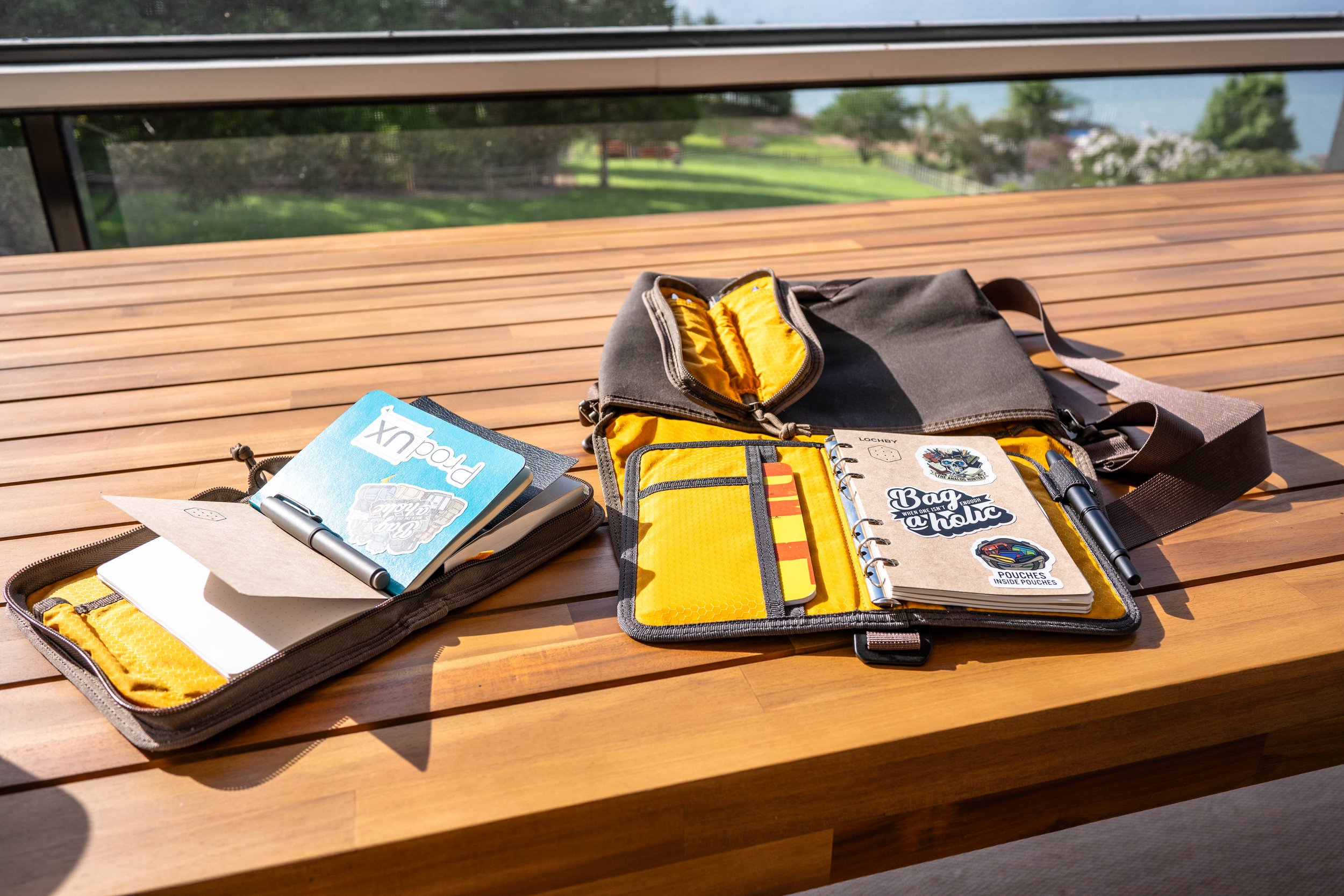
Lochby products
As a notebook enthusiast (almost a snob), I’ve tried many different styles and formats. When I first thought about binders in my notebooks again, I kept remembering elementary school and lugging around those huge 8.5 x 11-inch 3-ring versions. Let’s just say that wasn’t a joyful memory.
Although I love traditional-style notebooks and have a ton of them, now that I have been leveraging these smaller binder formats, the flexibility they provide is superb.
Bound notebooks impose a linear structure by design, which creates cognitive friction when it comes to putting pen to page. This cognitive friction is essentially worrying about order, or at least thinking about order. This is why the Bullet Journal by Ryder Carroll resonated with folks who are accustomed to traditional bound styles of notebooks. There must be a system that preserves the flexibility while minimizing friction for it to work well. The Bullet Journal System does this. It removes the cognitive load of using a linear format by leveraging a flexible system.
I still use traditional bound linear notebooks on a regular basis. The linear format works best when the subject is linear, like time or a calendar. For planning I absolutely love the Hobonichi notebooks and have been using the 2026 Techo A6 size. I don’t have the same mental block with this because the Techo’s format is linear by nature.
Using the calendar format in the Techo allows me to capture my daily activity: what happened on that day, what was important, etc. I don’t have to think about other topics, and I can keep things in order. It’s just a day and its details.
Even when I thought I had a good system with my Traveler’s Company Journals, I was really spreading this friction across multiple notebooks.
I used to rock the Traveler’s Journals in traditional and pocket sizes, and I still have them for specific occasions. The band system in these does provide a lot of flexibility in combining different notebooks, allowing you to organize your thoughts across different topic areas.
Obviously with binders you still can use dividers and organize topical areas, but you’re not faced with the same paralysis when it comes to writing on the page. The binder frees you up to not worry about order or placement. You can always change it; this freedom is incredibly gratifying. You’ll find yourself going with the flow and feeling less intimidated.
An added benefit of binders is the ability to discreetly dispose of items. If you write something that either has a limited shelf life or something you no longer value, it doesn’t disrupt the rest of the material. Decide what to keep and what to remove.
An additional benefit is in their archival capability.
It is much easier to remove pages by themselves to either take a photo or scan to create a digital copy. The individual pages lie flat, making it much easier to scan for archival purposes. In addition, you can purchase archival binders in the same sizes as your journal, allowing you to store pages outside your usual notebook.
Archiving traditional bound notebooks doesn’t require any additional purchases to archive; you simply store the notebook itself. Aside from work-specific notebooks, I have found it difficult to complete a notebook before changing interests or topics. The binder solves this.
The gear
When it comes to well-made handheld journals, there are many brands offering exceptional products. The ones that I have gravitated toward are The Traveler’s Company, Plotter, MeePlus, and Lochby. Lochby is the only one out of these not using leather material.
Lochby has traditionally created bound notebooks, similar to The Travelers Company notebooks, but they have now entered the binder arena with their new Field Binder series. I have been a huge fan of Lochby and own several sizes and variations in their traditional linear bound notebook formats. I hadn’t tried any of the ringed variants until this past year.
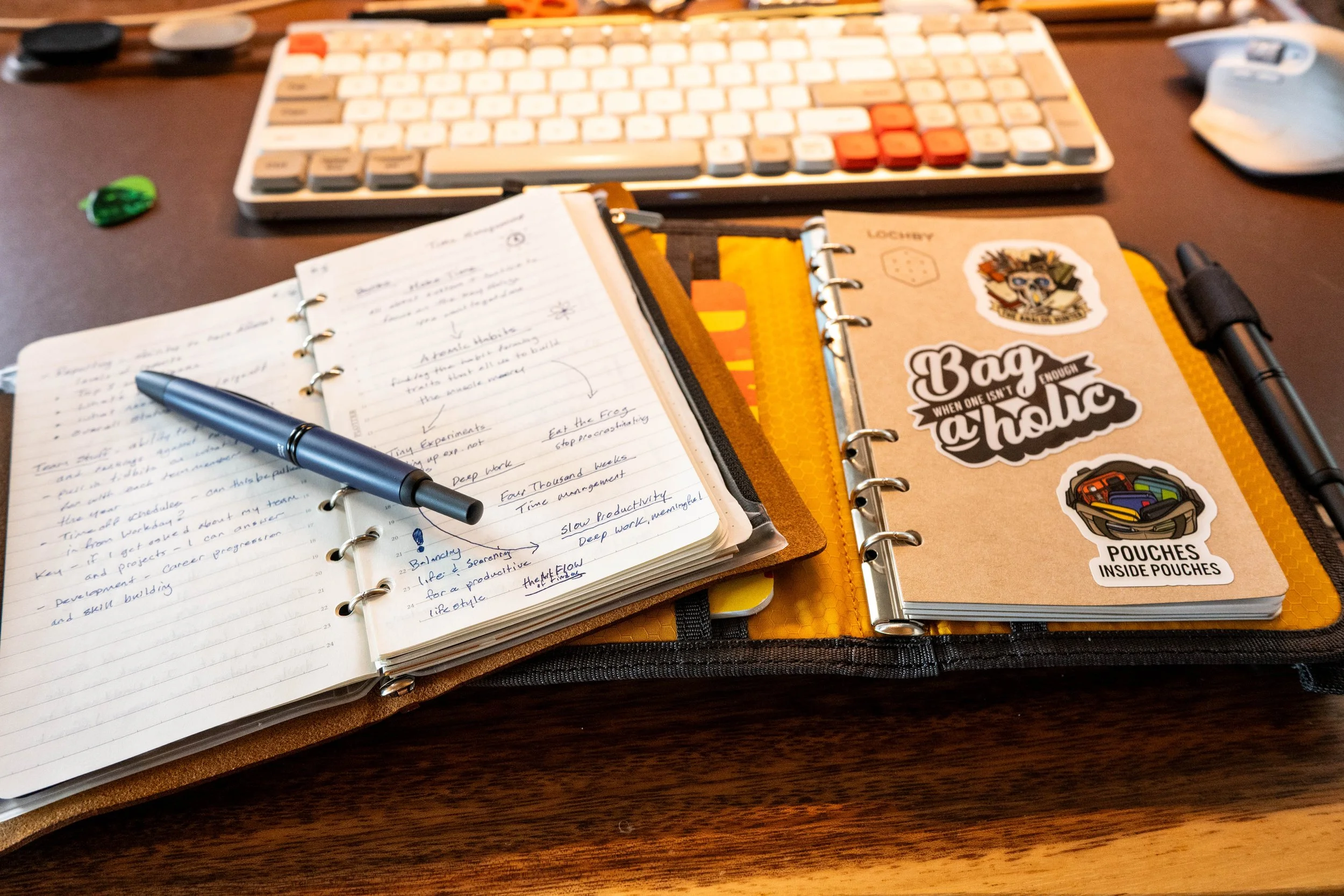
Plotter bible-sized journal & Lochby Field Binder in A6 size.
My first purchase and introduction into the world of ringed binder-style journals was a Bible-size Plotter, then came the Lochby in the A6 Field Binder series.
My current favorite size in any notebook is A6, and for the Plotter it’s the Bible size. The Bible size is almost the exact same size as the A6-sized notebooks. This form factor just works for me. The page is wide enough to capture a good line length and the height provides ample room for your written words, doodles, or whatever your heart desires.
Like The Travelers Journals, Plotter and MeePlus use fine leather materials in their application, while Lochby uses waxed canvas. Both are extremely solid choices and offer options for pen holders or loops.
I have now been using the Plotter in Bible size with Horween leather, which, to be honest, is exquisite. Right out of the box the leather feels wonderful and it has been a joy to use. I have a MeePlus on order in their personal size (their equivalent to Bible size) in Olive Pueblo leather. For the MeePlus I opted to get their 16mm rings for some extra space. I am interested in experiencing how the larger size changes the overall experience and how much it will be able to hold.
For Lochby, I have been using the A6 Field Folio and the new A6 Field Binder on a daily basis, and I like them for different reasons. The Folio gives you more flexibility when it comes to carrying extra stuff with its full zippered enclosure. For the notebooks, the Folio uses traditional-style bands (as the Traveler’s Series notebooks do) that can hold one or more bound notebooks. This folio can easily fit four-plus notebooks with ease.
When it comes to carrying several notebooks, the A6 size is small enough and can be easily carried or stacked, which doesn’t occupy much space.
I am a huge fan of fountain pens, which I assume most of us are, and when it comes to compatible paper this is where all of these shine. Both the Plotters and Lochby’s use Tomoe River paper, which seems to be the best for this application. Given their thin paper format there never seems to be any bleeding even with broader nibs and more ink flow. Truly wonderful!
The Lochby paper feels a bit thicker (or heavier) but not by much, and to me this makes writing feel smoother. MeePlus uses 120 g/m² (32 lb) paper, which they claim can handle fountain pens with ease. However, I haven’t had a chance to try these yet.
In closing
Have you struggled with your journaling practice?
Do you find yourself juggling notebooks to manage topics or ideas and end up starting new ones all the time? If so, then maybe a binder-style notebook system could be just the ticket to help you organize your thoughts.
Or maybe you have been a long-time user of a binder-style notebook and have been experiencing this bliss all along. If so I would love to hear how you use your notebook and any unique ways your productivity has increased due to this format.
I may be just late to this party but I am excited to dial in my workflow and system and will continue to share updates along the way.